 | InDesign SDK 20.5 |
#include <IM2MMessageListener.h>
Classes | |
| class | ChangeData |
| class | MessageHelper |
| class | PrivateData |
Public Types | |
| enum | { kDefaultIID = IID_IM2MMESSAGELISTENER } |
| enum | Relation { kHierAncestor = -2, kHierParent = -1, kTarget = 0, kHierChild = 1, kHierDescendent = 2, kUnrelated } |
Public Member Functions | |
| virtual void | GetMessagesFor (const IClassInfo *cInfo, const PMIID *&targetM, uint32 &targetMSize, const PMIID *&ancestorM, uint32 &ancestorMSize, const PMIID *&descendentM, uint32 &descendentMSize, const PMIID *&unrelatedM, uint32 &unrelatedMSize) const =0 |
| virtual void | Message (MessageHelper &helper, PrivateData *data)=0 |
| virtual PrivateData * | SnapshotRead (const UIDRef &targetRef, IPMStream *inStream)=0 |
 Public Member Functions inherited from IPMUnknown Public Member Functions inherited from IPMUnknown | |
| virtual IPMUnknown * | QueryInterface (PMIID interfaceID) const =0 |
| virtual void | AddRef () const =0 |
| virtual void | Release () const =0 |
Model To Model Listeners are a low level mechanism to "listen to" (vs Subject/Observer) changes to persistent objects in a database. It was used internally in CS4 to revise the way TextWrap and TextFrames detect changes to the the myriad number of properties and objects they depend on.
For example, MultiColumnTextFrames are dependent on their parent Spline for its stroke, stroke alignment, text inset, movement relative to the spread, etc.
Any changes to these properties requires explict action by the MCF to manage its size and/or text content.
Listeners are registered with K2 service providers thus:
Class

{

    kFooListenerServiceBoss,

    kInvalidClass,

    {

        IID_IK2SERVICEPROVIDER, kM2MMessageListenerServiceProviderImpl,

        IID_IM2MMESSAGELISTENER, kFooListenerImpl,

    }

}
Listeners can be attached to any persistent objects in the system and this attachment is determined by the M2MMessageManager on the first change to a persistent instance of a class by calling all the Listeners on their GetMessagesFor() method. A Listener which wishes to receive further notifcation of changes to any instance of the specified class must return a list of "messages" in the form of PMIIDs associated with the class.
The next time any implementation which implement one of the specified IIDs on that class changes the Listener will be called at its Message() method.
Listeners which use the MessageHelper::AddPrivateData() method to add PrivateData will be called back on their Validate() method when the Command Stack goes empty, typically, but not exclusively.
In Validate() they can fire commands (or make direct model changes) which will be associated with the same transaction as the command that is just finishing.
Listeners have several advantages over the traditional Subject/Observer mechanism:
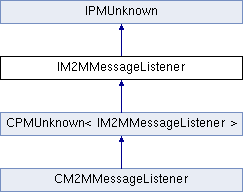
See CM2MMessageListener for a simplified way to implement Listeners which wish to have PrivateData (as most will).
The Relation enum describes the relationship in IHierarchy terms between the boss the Listener is listening to, specified by MessageHelper::GetTarget() and ValidateHelper::GetTarget(), and the boss the message was originated from.
Note that messages of Relation other than kTarget are by definition the result of a explit call by another Listener to forward the message from a boss that they are listening to to another boss. MessageHelper::Forward() is one way to do this.
| Enumerator | |
|---|---|
| kHierAncestor | The message is from a boss that is an ancestor to, but NOT the parent of, the boss the Listener is listening to. |
| kHierParent | The message is from a boss that is the parent of the boss the Listener is listening to. |
| kTarget | The message is from the boss that Listener is listening to. |
| kHierChild | The message is from a boss that is the child of the boss the Listener is listening to. |
| kHierDescendent | The message is from a boss that is the descendent of, but NOT the child of, the boss the Listener is listening to. |
| kUnrelated | The message is from a boss that is unrelated by IHierarchy to the boss the Listener is listening to. |
| pure virtual |
Return a pointer to the vector of PMIID messages that the Listener is interested in about the specified Class. If the Listener is not interested in the class then it should return nil.
Implemented in CM2MMessageListener.
| pure virtual |
Notification that a message has been sent to a boss listened to by the callee Listener. It is ASSERT()able that the only messages that a Listener will see are part of the set returned by what was returned from GetMessagesFor().
Listeners may only do direct modifications to data in this context (do not fire commands) and keep their work to a minimum in the interest of performance.
Those Listeners which need to do major work, such as firing commands, must create PrivateData and defer this work to a PrivateData::Validate() method.
| helper | Reference to ChangingHelper boss. |
| data | Reference to PrivateData class created in a previous call in the same M2MMessageManager 'transaction'. See MessageHelper::AddPrivateData(). |
Implemented in CM2MMessageListener.
| pure virtual |
A Listener which has previously created PrivateData is being called to create a new instance of PrivateData and initialize it from the snapshot (possibly) created by a previous call to PrivateData::SnapshotWrite().
Note that a Listener which does not change any state of their PrivateData during calls to Message() does not need to write anything out when called for SnapshotWrite(). However, the Listener will still be called at this method and will need to construct and return a new instance of their PrivateData().
| targetRef | UIDRef to object the Listener is associated with |
| inStream | Pointer to IPMStream input stream positioned at the snapshot data (if any) previously written in a call to PrivateData::SnapshotWrite() |
Implemented in CM2MMessageListener.
 1.8.3.1
