 | InDesign SDK 20.5 |
#include <ITableAttrGradient.h>
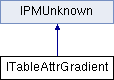
Public Types | |
| enum | { kDefaultIID = IID_ITABLEATTRGRADIENT } |
Public Member Functions | |
| virtual PMPoint | GetStartPt (const PMRect &area=kUnitArea) const =0 |
| virtual void | SetStartPt (const PMPoint &value, const PMRect &area=kUnitArea)=0 |
| virtual PMReal | GetAngle (const PMRect &area=kUnitArea) const =0 |
| virtual PMReal | GetLength (const PMRect &area=kUnitArea) const =0 |
| virtual void | SetEndPt (const PMReal &length, const PMReal &angle, const PMRect &area=kUnitArea)=0 |
| virtual PMReal | GetHiliteAngle (const PMRect &area=kUnitArea) const =0 |
| virtual PMReal | GetHiliteLength (const PMRect &area=kUnitArea) const =0 |
| virtual void | SetHilite (const PMReal &length, const PMReal &angle, const PMRect &area=kUnitArea)=0 |
| virtual bool16 | IsEqual (const ITableAttrGradient *rhs) const =0 |
| virtual void | SetAngle (const PMReal &angle)=0 |
| virtual void | SetLength (const PMReal &length)=0 |
 Public Member Functions inherited from IPMUnknown Public Member Functions inherited from IPMUnknown | |
| virtual IPMUnknown * | QueryInterface (PMIID interfaceID) const =0 |
| virtual void | AddRef () const =0 |
| virtual void | Release () const =0 |
Abstract interface representing table attribute that stores gradient parameters. Both the fill and the stroke of a cell in a table can have gradient attributes associated.
Accessor for the gradient angle.
Angle and length specify a vector that is anchored at start point and points to the end point. For a linear gradient this specifies the rectangle in the table frame that encompasses the gradient. For a radial gradient this defines the inner disk. Note that angles are in degrees...
| area | – usually the bounds of the Table Frame, point is returned relative to the area, if no area is passed in then the normalized point is returned |
| pure virtual |
Accessor for the hilite angle, only relevant to radial gradients.
Hilite length and hilite angle are only used for radial gradients when you click (not drag) with the gradient tool. They are used to define the outer circle.
| area | – usually the bounds of the Table Frame, point is returned relative to the area, if no area is passed in then the normalized point is returned |
| pure virtual |
Accessor for the hilite length, only relevant to radial gradients.
| area | – usually the bounds of the Table Frame, length is returned relative to the area, if no area is passed in then the normalized length is returned |
Accessor for the gradient length. See GetAngle().
| area | – usually the bounds of the Table Frame, length is returned relative to the area, if no area is passed in then the normalized length is returned |
Accessor for the gradient "start-point".
For linear gradients this is the start point. For radial gradients this is the inner center point.
| area | – usually the bounds of the Table Frame, point is returned relative to the area, if no area is passed in then the normalized point is returned |
| pure virtual |
Method to allow a comparison of this gradient attribute and a comparand.
| rhs | specifies the gradient to compare this gradient against |
| pure virtual |
Mutator for the angle
Use SetAngle & SetLength only if you call SetStartPt with kUnitArea. See GetAngle for dicussion of angle
| angle | of normalized vector |
| pure virtual |
Mutator for the gradient end-point.
| length | |
| angle | |
| area | – usually the bounds of the Table Frame to normalize the point, if no value is passed in we assume it is normalized |
| pure virtual |
Mutator for the hilite length, only relevant to radial gradients.
| length | |
| angle | |
| area | – usually the bounds of the Table Frame to normalize the point, if no value is passed in we assume it is normalized |
| pure virtual |
Mutator for the gradient length.
Use SetAngle & SetLength only if you call SetStartPt with kUnitArea. See GetAngle for discussion of length.
| length | length of normalized vector |
| pure virtual |
Mutator for the gradient "start-point".
For linear gradients this is the start point. For radial gradients this is the inner center point.
| value,: | New StartPt |
| area | – usually the bounds of the Table Frame to normalize the point, if no value is passed in we assume it is normalized |
 1.8.3.1
