 | InDesign SDK 20.5 |
#include <ITextAttrSpecialGlyph.h>
Public Types | |
| enum | { kDefaultIID = IID_ITEXTATTRSPECIALGLYPH } |
| typedef const char * | ValueType |
| typedef Text::GlyphID | AlternateValueType |
Public Member Functions | |
| virtual void | Set (ValueType flag)=0 |
| virtual ValueType | Get () const =0 |
| virtual void | SetGlyphID (AlternateValueType g)=0 |
| virtual AlternateValueType | GetGlyphID () const =0 |
 Public Member Functions inherited from IPMUnknown Public Member Functions inherited from IPMUnknown | |
| virtual IPMUnknown * | QueryInterface (PMIID interfaceID) const =0 |
| virtual void | AddRef () const =0 |
| virtual void | Release () const =0 |
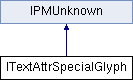
This is used to set a glyph name or glyph id for a glyph with no unicode value. The unicode value kTextChar_SpecialGlyph or kTextChar_NonRomanSpecial is used in the story to indicate that this attribute should be used for the glyph id. When this attribute is constructed glyph name is nil and GlyphID is 0. Normally you will only set either the glyph name or the glyph id.
| pure virtual |
Gets the glyph name for the attribute. May be nil if only ID is set.
| pure virtual |
Get glyph id for attribute.
| pure virtual |
Set to glyph name. The name is used first to find a glyph in the fonts. If no glyph is found the value set by SetGlyphID will be used. Calling this does not reset glyph id. These names are usually obtained from IPMFont::GetGlyphName. Glyph names are prefferable to glyph ids because when switching fonts glyph ids may not represent the same glyph but glyph names are more likely to represent the same glyph.
| flag | glyph name to set |
| pure virtual |
Set glyph id for attribute. This will set glyph name to nil. A glyph id is only reliable across font changes if the 2 fonts have the same font registry and font ordering.
| g | glyph id to set for attribute |
 1.8.3.1
