 | InDesign SDK 20.5 |
#include <K2Vector.h>
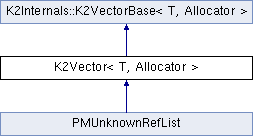
Public Member Functions | |
| K2Vector () | |
| K2Vector (typename Allocator::size_type count, const T &value) | |
| K2Vector (const K2Vector &rhs)=default | |
| K2Vector (K2Vector &&rhs) noexcept=default | |
| K2Vector & | operator= (const K2Vector &rhs)=default |
| K2Vector & | operator= (K2Vector &&rhs) noexcept=default |
| template<class InputIterator > | |
| K2Vector (InputIterator first, InputIterator last, const Allocator &a) | |
| template<class InputIterator > | |
| K2Vector (InputIterator first, InputIterator last) | |
| void | swap (K2Vector &other) noexcept |
 Public Member Functions inherited from K2Internals::K2VectorBase< T, Allocator > Public Member Functions inherited from K2Internals::K2VectorBase< T, Allocator > | |
| K2VectorBase (const Allocator &a=Allocator()) | |
| K2VectorBase (size_type count, const T &value, const Allocator &a=Allocator()) | |
| template<class InputIterator > | |
| K2VectorBase (InputIterator first, InputIterator last, const Allocator &a) | |
| template<class InputIterator > | |
| K2VectorBase (InputIterator first, InputIterator last) | |
| void | initialize (size_type count, const T &value) |
| void | fill_assign (size_type, const T &) |
| void | fill_insert (iterator, size_type, const T &) |
| K2VectorBase (const K2VectorBase &rhs) | |
| K2VectorBase (K2VectorBase &&rhs) noexcept | |
| void | CopyConstructHelper (const K2VectorBase &rhs) |
| iterator | begin () |
| const_iterator | begin () const |
| iterator | end () |
| const_iterator | end () const |
| reverse_iterator | rbegin () |
| const_reverse_iterator | rbegin () const |
| reverse_iterator | rend () |
| const_reverse_iterator | rend () const |
| size_type | size () const |
| size_type | max_size () const |
| size_type | capacity () const |
| bool16 | empty () const |
| allocator_type | get_allocator () const |
| K2VectorBase & | operator= (const K2VectorBase &rhs) |
| K2VectorBase & | operator= (K2VectorBase &&rhs) noexcept |
| void | reserve (size_type capacity) |
| template<class InputIter > | |
| void | assign (InputIter first, InputIter last) |
| void | assign (size_type count, const T &u) |
| reference | operator[] (size_type i) |
| const_reference | operator[] (size_type i) const |
| const_reference | at (size_type i) const |
| reference | at (size_type i) |
| reference | front () |
| const_reference | front () const |
| reference | back () |
| const_reference | back () const |
| void | push_back (const T &x) |
| void | pop_back () |
| iterator | insert (iterator position, const T &x) |
| void | insert (iterator position, size_type n, const T &x) |
| template<class InputIter > | |
| void | insert (iterator pos, InputIter first, InputIter last) |
| iterator | erase (iterator position) |
| iterator | erase (iterator first, iterator last) |
| void | swap (K2VectorBase &) noexcept |
| void | clear () |
| void | resize (size_type newsize, const T &value) |
| void | DoCleanup () |
| size_type | DoGetCapacity (size_type newLength) |
| void | DoReset (pointer newData, size_type newLength, size_type newCap) |
Static Public Member Functions | |
| static Method | ForceInstantiation (int n) |
Additional Inherited Members | |
| Public Types inherited from K2Internals::K2VectorBase< T, Allocator > | |
| typedef object_type | data_type |
| typedef T | value_type |
| typedef value_type * | pointer |
| typedef const value_type * | const_pointer |
| typedef value_type * | iterator |
| typedef const value_type * | const_iterator |
| typedef value_type & | reference |
| typedef const value_type & | const_reference |
| typedef uint32 | size_type |
| typedef std::ptrdiff_t | difference_type |
| typedef Allocator | allocator_type |
| typedef K2Reverse_iterator < iterator, value_type, difference_type, pointer, reference > | reverse_iterator |
| typedef K2Reverse_iterator < const_iterator, value_type, difference_type, const_pointer, const_reference > | const_reverse_iterator |
K2Vector is an implementation of STL's vector class.
Summary: There are three differences between K2Vector and std::vector:
1) the K2Vector(uint32) ctor reserves space instead of resizing the array;
2) a number of deprecated methods have been added for backward compatibility;
and 3) K2Vector distinguishes between base types (no copy constructor needed) and object types (need copy constructor) - for element copying performance reasons, using two typedefs that you can use in the public section of your data structures:
typedef object_type data_type;
and
typedef base_type datatype;
Which you choose depends upon whether your struct or class includes any data member that itself requires construction. If so then choose object_type; otherwise choose base_type. If you choose base_type, this naturally means that your object has become fragile because somebody later might extend your class by adding data members that require construction, yet they might forget to change the typedef. On the other hand, if object construction is not required then base_type is much faster.
So, why do we need to define our own vector class? The problem with the compiler provided STL implementations is that they are not interface classes and we have no control over the implementation. So, if an interface in Public returns a reference to a std::vector a plugin compiled with a different version of the compiler may experience difficulties since the internals of the vector may have changed.
| inlineexplicit |
Default constructor. Creates an empty vector.
| inline |
Constructs a vector initialized with <count> copies of element
.
| count | [IN] - the number of copies of the specified element. |
| value | [IN] - the element used for initialization. |
| default |
Copy constructor. Creates a new vector as a copy of another vector of the same type (all elements are copied).
| rhs | [IN] - the source vector to be copied. |
| inline |
Creates a vector that is initialized with all the elements of the range [first, last).
| first | [IN] - iterator that points to the first element in the source sequence. |
| last | [IN] - iterator that points AFTER the last element to be copied. |
| a | [IN] - allocator to be used. |
| inline |
Creates a vector that is initialized with all the elements of the range [first, last).
| first | [IN] - iterator that points to the first element in the source sequence. |
| last | [IN] - iterator that points AFTER the last element to be copied. |
 1.8.3.1
