 | InDesign SDK 20.5 |
#include <PMString.h>
Classes | |
| struct | wchar_size |
Public Member Functions | |
| PMString (ConstCString key, TranslateDuringCall translate=kDontTranslateDuringCall) | |
| PMString (const UTF16TextChar *string, int32 nDblBytes) | |
| PMString (const wchar_t *s) | |
| PMString (const wchar_t *s, size_t len) | |
| PMString (adobe::move_from< PMString > other) | |
| PMString (PMString &&other) noexcept | |
| PMString (const PMString &s) | |
| PMString (const WideString &s) | |
| void | SetString (const PMString &s) |
| void | SetKey (ConstCString key, TranslateDuringCall translate=kDontTranslateDuringCall) |
| void | GetWChar_tString (wchar_t *wchar_tString, int32 bufferSize) const |
| void | SetXString (const UTF16TextChar *x, int32 nDblBytes) |
| PMString & | assign (const wchar_t *s, size_t len) |
| std::string | GetUTF8String () const |
| void | SetUTF8String (const std::string &utf8String) |
| UTF32TextChar | GetWChar (int32 pos) const |
| int32 | WCharLength (void) const |
| bool16 | empty () const |
| void | clear () |
| void | Append (const PMString &s, CharCounter nCharacters=kMaxInt32) |
| void | Append (const WideString &s) |
| void | AppendW (const UTF16TextChar *ws, int32 nDblBytes=kMaxInt32) |
| void | AppendW (UTF32TextChar wc) |
| void | append (const wchar_t *s) |
| void | Insert (const PMString &s, CharCounter pos=0, CharCounter nCharacters=kMaxInt32) |
| void | InsertW (const UTF16TextChar *ws, int32 nDblBytes=kMaxInt32, int32 pos=0) |
| void | InsertW (UTF32TextChar wc, int32 pos=0) |
| PMString * | Substring (CharCounter pos, CharCounter count=kMaxInt32) const |
| PMString * | GetItem (const PMString &delimiter, const int32 nItem) const |
| void | Remove (CharCounter pos, CharCounter count=1) |
| void | Truncate (CharCounter count=1) |
| void | StripWhiteSpace (WhitespaceType wsType=kAllWhiteSpace) |
| CharCounter | IndexOfString (const PMString &keyString, CharCounter pos=0) const |
| CharCounter | LastIndexOfString (const PMString &keyString) const |
| CharCounter | IndexOfWChar (UTF32TextChar wc, int32 pos=0) const |
| CharCounter | LastIndexOfWChar (UTF32TextChar wc) const |
| bool16 | Contains (const PMString &searchString, CharCounter pos=0) const |
| bool16 | BeginsWith (const PMString &searchString, CharCounter pos=0) const |
| bool16 | ParseForEmbeddedCharacters () |
| int32 | Compare (bool16 casesensitive, const PMString &s) const |
| bool16 | IsEqual (const PMString &s, bool8 casesensitive=kTrue, bool8 limitCompareToShorterLength=kFalse) const |
| bool16 | operator== (const PMString &s) const |
| bool16 | operator== (ConstCString key) const |
| bool16 | operator!= (const PMString &s) const |
| bool16 | operator< (const PMString &s) const |
| bool16 | operator> (const PMString &s) const |
| bool16 | operator<= (const PMString &s) const |
| bool16 | operator>= (const PMString &s) const |
| PMString & | operator+= (const PMString &s) |
| PMString & | operator= (const PMString &other) |
| PMString & | operator= (PMString &&other) noexcept |
| uint32 | Hash (void) const |
| void | AppendNumber (int32 i) |
| void | AppendNumber (const PMReal &r, int32 digitsPrecision=-1, bool16 round=kFalse, bool16 eliminateTrailingZeros=kFalse) |
| void | AsNumber (int32 i) |
| void | AsNumber (const PMReal &r, int32 digitsPrecision=-1, bool16 round=kFalse, bool16 eliminateTrailingZeros=kFalse) |
| void | AppendFixed (Fixed f) |
| void | AsFixed (Fixed f) |
| int32 | GetAsNumber (ConversionError *pError=nil, CharCounter *lenNotConverted=nil) const |
| double | GetAsDouble (ConversionError *pError=nil, CharCounter *lenNotConverted=nil) const |
| void | ToUpper (void) |
| void | ToLower (void) |
| void | ReadWrite (IPMStream *s) |
| void | ReadWriteKey (IPMStream *s) |
| void | ReadPlatformWriteUnicode (IPMStream *s, PMString::StringPlatformEncoding encoding=kPlatformEncodingOther, bool16 includeBools=kTrue) |
| bool16 | Translate (const PMLocaleId &locale) |
| bool16 | Translate () |
| bool16 | IsTranslatable () const |
| PMString & | SetTranslatable (bool16 shouldTranslate) |
| bool16 | HasTranslated () const |
| void | SetTranslated () |
| PMString (ConstCString string, PMString::StringEncoding encoding) | |
| void | SetPString (ConstPString p, PMString::StringEncoding encoding) |
| void | SetCString (ConstCString C, PMString::StringEncoding encoding) |
| void | SetXString (const char *x, int32 nBytes, PMString::StringEncoding encoding=kUnknownEncoding) |
| void | GetPString (PString p, int32 bufferSize, PMString::StringEncoding encoding=kUnknownEncoding) const |
| void | GetCString (CString C, int32 bufferSize, PMString::StringEncoding encoding=kUnknownEncoding) const |
| std::string | GetPlatformString (PMString::StringEncoding encoding=kUnknownEncoding) const |
| void | Insert (const char *ps, int32 nBytes=kMaxInt32, CharCounter pos=0, PMString::StringEncoding encoding=kUnknownEncoding) |
| void | Insert (char pc, CharCounter pos=0, PMString::StringEncoding encoding=kUnknownEncoding) |
| void | Insert (const PlatformChar &pc, CharCounter pos=0) |
| void | Append (const char *ps, int32 nBytes=kMaxInt32, PMString::StringEncoding encoding=kUnknownEncoding) |
| void | Append (char pc, PMString::StringEncoding encoding=kUnknownEncoding) |
| void | Append (const PlatformChar &pc) |
| const PlatformChar | operator[] (CharCounter index) const |
| const PlatformChar | GetChar (CharCounter pos, PMString::StringEncoding encoding=kUnknownEncoding) const |
| CharCounter | IndexOfCharacter (const PlatformChar &pc, CharCounter pos=0) const |
| CharCounter | LastIndexOfCharacter (const PlatformChar &pc) const |
| uint8 | GetScript () const |
| void | SetScript (uint8 script) |
| PMString::StringEncoding | GetEncoding () const |
| void | SetEncoding (PMString::StringEncoding encoding) |
| const UTF16TextChar * | GrabWString (void) const |
| void | SetCString (ConstCString C) |
| bool16 | IsNull (void) const |
| bool16 | IsEmpty () const |
| void | Clear (void) |
 Public Member Functions inherited from UnicodeSavvyString Public Member Functions inherited from UnicodeSavvyString | |
| bool16 | HasMultiWordUnicode () const |
| size_type | CharCount () const |
| size_type | NumUTF16TextChars () const |
| size_type | capacity (void) const |
| void | reserve (size_type newCapacity) |
| void | resize (size_type newSize, code_value fill=code_value()) |
| void | clear () |
| const UTF16TextChar * | GrabUTF16Buffer (int32 *numUTF16s) const |
| int32 | CodePointIndexToUTF16Index (int32 index) const |
| void | Truncate (CharCounter count) |
| void | Remove (int32 position, CharCounter count) |
| UTF32TextChar | GetUTF32TextChar (int32 pos) const |
| const_code_value_iterator | begin () const |
| const_code_value_iterator | end () const |
Protected Member Functions | |
| void | AssignToPlatformBuffer (ConstCString src, int32 lengthInBytes) |
| Protected Member Functions inherited from UnicodeSavvyString | |
| UnicodeSavvyString (adobe::move_from< UnicodeSavvyString > other) | |
| UnicodeSavvyString (UnicodeSavvyString &&other) noexcept | |
| void | move_from (UnicodeSavvyString &other) noexcept |
| template<class IteratorType > | |
| UnicodeSavvyString (IteratorType b, IteratorType e, size_type nCodePoints=0) | |
| int32 | CountChars () const |
| int32 | CountCharsUtil (const UTF16TextChar *buffer, int32 bufferLength) const |
| void | InsertGap (uint32 wordWiseIndex, size_type numberOfSpaces) |
| void | RemoveGap (uint32 wordWiseIndex, size_type numberOfSpaces) |
| void | InsertUTF32TextChar (UTF32TextChar c, int32 pos=0) |
| void | InsertUTF16String (const UTF16TextChar *buf, int32 len, int32 position=0) |
| void | AppendUTF32TextChar (UTF32TextChar c32) |
| void | CopyFrom (const UnicodeSavvyString &other) |
| bool16 | operator== (const UnicodeSavvyString &s) const |
| template<class IteratorType > | |
| UnicodeSavvyString & | assign (IteratorType b, IteratorType e, size_type nCodePoints=0) |
| UnicodeSavvyString & | replace (size_type pos, size_type n1, code_value const *s, size_type n2) |
| UnicodeSavvyString & | append (code_value const *s, size_type nCodeValues, size_type nCodePoints=0) |
| UTF32TextChar | surro_GetUTF32TextChar (int32 pos) const |
| const UTF16TextChar * | ConstBuffer () const |
| void | insert_safe (code_value_iterator i, const_code_value_iterator sb, const_code_value_iterator se) |
| void | erase_safe (code_value_iterator b, code_value_iterator e) |
| void | replace_safe (code_value_iterator b, code_value_iterator e, const_code_value_iterator sb, const_code_value_iterator se) |
| template<class InputIterator > | |
| void | assign_impl (InputIterator b, InputIterator e, size_type nCodePoints, std::input_iterator_tag) |
| template<class FwdIterator > | |
| void | assign_impl (FwdIterator b, FwdIterator e, size_type nCodePoints, std::forward_iterator_tag) |
| bool16 | UnicodeBufferIsValid () const |
| UTF16TextChar * | GetBufferForWriting (size_type size) |
Friends | |
| PMString | operator+ (const PMString &s1, const PMString &s2) |
| void | swap (PMString &left, PMString &right) noexcept |
Additional Inherited Members | |
| Protected Types inherited from UnicodeSavvyString | |
| enum | { kMaxSmallString = 23 } |
| Protected Attributes inherited from UnicodeSavvyString | |
| StringStorage * | fStorage |
| UTF16TextChar | fSmallStorage [kMaxSmallString+1] |
| size_type | fUTF16BufferLength |
| size_type | fNumChars |
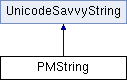
PMString is used for strings that show in the UI. Given a key then calling Translate will lookup the translation for the key for the current UI locale. This class should not be used for strings that are not in the UI. Please use WideString for strings that do not need to be translated.
Error in converting string to number
| Enumerator | |
|---|---|
| kNoError | No Error. |
| kNoNumber | String has no number. |
| kNotJustNumber | String has more than just number. |
What kind of encoding to use to represent the platform string as. These are platform specific. If running on mac this is mac encoding. On windows it is windows encoding. You should persist Unicode if you want to take data cross platform. Comments for encoding list Macintosh script first than Windows codepage.
What kind of encoding to use to convert to unicode
Specify whether to translate during call
| Enumerator | |
|---|---|
| kDontTranslateDuringCall | Keep as key string. calling Translate will give translation. |
| kTranslateDuringCall | Translate during call |
What kind of white space to strip
| PMString::PMString | ( | ConstCString | key, |
| TranslateDuringCall | translate = kDontTranslateDuringCall | ||
| ) |
Constuctor Construct PMString using a ascii key. Caller is responsible for the memory of ConstCString key. Keys are the first string of the string pair in a resource StringTable.
| key | platform C string. Need to be null terminated. |
| translate | using kTranslateDuringCall will put the translation in the string. The key will be lost. |
| PMString::PMString | ( | const UTF16TextChar * | string, |
| int32 | nDblBytes | ||
| ) |
Constuctor
| string | IN Unicode representation (in UTF-16 encoding) of the string for initialization. This string need not be null-terminated |
| nDblBytes | IN The number of 16-bit values in the string buffer. This value may be greater than the number of characters represented since UTF-16 can contain surrogate pairs, each of which represents a single character. Composed characters are not supported |
| explicit |
Constructs from Unicode characters. Allows construction of a PMString from L"" constants. On Windows wchar_t matches UTF16, on the Mac they are UTF32s. NOTE: This should be used to set strings that are not keys. Calling Translate on this string will do nothing. If you want to translate the string use SetKey.
| s | [IN] - buffer containing wchar_t characters. Needs to be null terminated. |
| PMString::PMString | ( | const wchar_t * | s, |
| size_t | len | ||
| ) |
Constructs from Unicode characters. On Windows wchar_t matches UTF16, on the Mac they are UTF32s. NOTE: This should be used to set strings that are not keys. Calling Translate on this string will do nothing. If you want to translate the string use SetKey.
| s | [IN] - buffer containing wchar_t characters. Doesn't have to be null terminated since the len parameter is mandatory. |
| len | [IN] - number of wchar_t's in s to be read. |
| inline |
Movable constructor - assumes ownership of the remote part.
| PMString::PMString | ( | ConstCString | string, |
| PMString::StringEncoding | encoding | ||
| ) |
Constuctor
Set PMString using a platform string. Same as calling - SetCString(ConstCString C, PMString::StringEncoding encoding) This should be used to set strings that are not keys. Calling Translate on this string will do nothing. If you want to translate use the constructor without encoding - PMString(ConstCString key, TranslateDuringCall translate = kDontTranslateDuringCall);
If it is not a key first consider using WideString. If you are you are using a string you don't want to be the same in all languages consider adding it as a key to the notranslate table.
| string | C string to set PMString to. Make sure script of passed in C string matchs the script of the PMString. |
| encoding | The desired script of the platform representation of this string. The default value creates a PMString with the encoding set appropriately for the current operating environment of the operating system: ASCII for English language systems, ShiftJIS for Japanese systems, etc. It is recommended that this parameter be set explicitly, however. |
| void PMString::Append | ( | const PMString & | s, |
| CharCounter | nCharacters = kMaxInt32 | ||
| ) |
Append the first n characters of s onto this string.
| s | string to append |
| nCharacters | number of characters in s to append |
| void PMString::Append | ( | const WideString & | s | ) |
Append a WideString
| s | WideString to append |
| void PMString::append | ( | const wchar_t * | s | ) |
Append Unicode characters. Allows appending L"" constants to the PMString. On Windows wchar_t matches UTF16, on the Mac they are UTF32s. This does not change whether the string is translatable or not.
| s | [IN] - buffer containing wchar_t characters. Needs to be null terminated. |
| void PMString::Append | ( | const char * | ps, |
| int32 | nBytes = kMaxInt32, | ||
| PMString::StringEncoding | encoding = kUnknownEncoding | ||
| ) |
Append a series of characters which may have NO or MULTIPLE nul characters. No length checking is performed
| ps | platform string. |
| nBytes | number of bytes in ps to append |
| encoding | encoding of ps |
| void PMString::Append | ( | char | pc, |
| PMString::StringEncoding | encoding = kUnknownEncoding | ||
| ) |
Append a platform or ascii character [replaces Append(char c)]
RECOMMENDATION -

If you are appending a hard coded value look for the value in TextChar.h and call AppendW(UTF32TextChar wc).
| pc | platform character. |
| encoding | encoding of pc |
| void PMString::Append | ( | const PlatformChar & | pc | ) |
Append a platform or ascii character [replaces Append(char c)]
| pc | platform character. |
| inline |
Append fixed number as string to existing string.
| f | fixed to to convert to string and append |
| void PMString::AppendNumber | ( | int32 | i | ) |
Append number as string to existing string.
| i | number to convert to string and append to existing string. |
| void PMString::AppendNumber | ( | const PMReal & | r, |
| int32 | digitsPrecision = -1, | ||
| bool16 | round = kFalse, | ||
| bool16 | eliminateTrailingZeros = kFalse | ||
| ) |
Append number as string to existing string.
| r | number to convert to string and append to existing string. |
| digitsPrecision | how many decimal points to show. -1 means show all |
| round | if kTrue value is rounded else value is floored. Only used if digitsPrecision is > -1. |
| eliminateTrailingZeros | if kTrue trailing zeros are not in string |
| void PMString::AppendW | ( | const UTF16TextChar * | ws, |
| int32 | nDblBytes = kMaxInt32 | ||
| ) |
Append a Unicode string
| ws | string to append |
| nDblBytes | number of UTF16s to append |
| void PMString::AppendW | ( | UTF32TextChar | wc | ) |
Append a Unicode character
| wc | character to append |
| inline |
Set string to fixed value.
| f | fixed to convert to string. |
| void PMString::AsNumber | ( | int32 | i | ) |
Set string to value.
| i | value to convert to string |
| void PMString::AsNumber | ( | const PMReal & | r, |
| int32 | digitsPrecision = -1, | ||
| bool16 | round = kFalse, | ||
| bool16 | eliminateTrailingZeros = kFalse | ||
| ) |
Set string to value.
| r | PMReal to convert to string |
| digitsPrecision | how many decimal points to show. -1 means show all |
| round | if kTrue value is rounded else value is floored. Only used if digitsPrecision is > -1. |
| eliminateTrailingZeros | if kTrue trailing zeros are not in string |
| inline |
Sets the content of the PMString using a non-translatable Unicode string.
The string will be marked as non-translatable.
| s | Unicode buffer. Does not need to be null terminated as len determines how much it will be read. |
| len | number of wchar_t in s to be read to set PMString. Do not include count of null terminator. |
| bool16 PMString::BeginsWith | ( | const PMString & | searchString, |
| CharCounter | pos = 0 | ||
| ) | const |
Returns true if string starts with searchString
| searchString | string to look for |
| pos | where to start looking. |
| void PMString::clear | ( | ) |
| inline |
| int32 PMString::Compare | ( | bool16 | casesensitive, |
| const PMString & | s | ||
| ) | const |
Lexicographically compares strings like strcmp or stricmp, except based on UNICODE values. If both strings are roman encoded then compared based on platform values instead of Unicode.
| casesensitive | if kTrue use case to compare |
| s | string to compare to |
| bool16 PMString::Contains | ( | const PMString & | searchString, |
| CharCounter | pos = 0 | ||
| ) | const |
Returns true if string contains searchString
| searchString | string to look for |
| pos | where to start looking. |
| bool16 PMString::empty | ( | ) | const |
Number of characters is 0.
| double PMString::GetAsDouble | ( | ConversionError * | pError = nil, |
| CharCounter * | lenNotConverted = nil | ||
| ) | const |
Try to interpert the string as a double.
| pError | sets to a ConversionError if the entire string cannot be converted. |
| lenNotConverted | number of characters at the end that were not converted |
| int32 PMString::GetAsNumber | ( | ConversionError * | pError = nil, |
| CharCounter * | lenNotConverted = nil | ||
| ) | const |
Try to interpert the string as a number.
| pError | sets to a ConversionError if the entire string cannot be converted. |
| lenNotConverted | number of characters at the end that were not converted |
| const PlatformChar PMString::GetChar | ( | CharCounter | pos, |
| PMString::StringEncoding | encoding = kUnknownEncoding | ||
| ) | const |
returns the platform encoded character (as a PlatformChar) at a specific character offset
| pos | IN The character position (0-based) of the desired character. Note that embedded characters shown in the format "<1234>" returned from GrabCString() count as a single character, which will be returned as an invalid PlatformChar |
| encoding | encoding to get character as |
| void PMString::GetCString | ( | CString | C, |
| int32 | bufferSize, | ||
| PMString::StringEncoding | encoding = kUnknownEncoding | ||
| ) | const |
Gets a C string. If bufferSize is not big enough the call returns and does not copy anything to the buffer c.
| C | OUT A pointer to string of bufferSize which will be filled in with the characters of the string represented in GetEncoding() encoding. |
| bufferSize | IN the size of the provided buffer measured in bytes, including space for the terminating zero. |
| PMString::StringEncoding PMString::GetEncoding | ( | ) | const |
Provide the current encoding of the platform buffer for the string
PORTING RECIPE - Encoding (also known as script) should be obtained when calling a routing that gets a platform string. After the encoding if put at the point of the call this API should be removed.
Returns the specified token/item of a string, given a single delimiter
| delimiter | IN The string to use as a delimiter |
| nItem | IN The one based item number for the the desired item |
| std::string PMString::GetPlatformString | ( | PMString::StringEncoding | encoding = kUnknownEncoding | ) | const |
Gets a platform string. Check to make sure the code really wants a plaform encoded string if instead it wants utf8 you can call GetUTF8String
| encoding | encoding for string to return. |
| void PMString::GetPString | ( | PString | p, |
| int32 | bufferSize, | ||
| PMString::StringEncoding | encoding = kUnknownEncoding | ||
| ) | const |
Get pascal string. If PMString byte length is greater than 255 all bytes will still be copied to the buffer but the lenght byte will be truncated to 255. If bufferSize is not big enough the call returns and does not copy anything to the buffer p.
RECOMMENDATION - See if this API is used for a Macintosh API call see if there is a new version of the API that takes a CFString.
| p | OUT A pointer to string of bufferSize which will be filled in with the characters of the string represented in GetEncoding() encoding. |
| bufferSize | IN the size of the provided buffer measured in bytes, including space for the length byte. |
| encoding | encoding of pascal string. |
| uint8 PMString::GetScript | ( | ) | const |
OBSOLETE. Use GetEncoding instead
PORTING RECIPE - Encoding (also known as script) should be obtained when calling a routing that gets a platform string. After the encoding is put at the point of the call this API should be removed.
| std::string PMString::GetUTF8String | ( | ) | const |
Gets a std::string encoded as UTF8.
| UTF32TextChar PMString::GetWChar | ( | int32 | pos | ) | const |
returns the double byte textchar at a specific character offset into the Unicode string representation.
| pos | character offset. O based. |
| void PMString::GetWChar_tString | ( | wchar_t * | wchar_tString, |
| int32 | bufferSize | ||
| ) | const |
Get a null terminated wchar_t string.
| wchar_tString | OUT returns string as wchar_t string |
| bufferSize | size of wchar_tString buffer |
| const UTF16TextChar* PMString::GrabWString | ( | void | ) | const |
DEPRECATED: Use GrabUTF16Buffer
PORTING RECIPE - Use GrabUTF16Buffer(nil)
| uint32 PMString::Hash | ( | void | ) | const |
Provide a binary hash value based on numeric codes
| bool16 PMString::HasTranslated | ( | ) | const |
String has been translated. Calling Translate will set this to kTrue if IsTranslatable is kTrue and the string length is greater than 0. Also calling SetTranslated will set this to kTrue.
| CharCounter PMString::IndexOfCharacter | ( | const PlatformChar & | pc, |
| CharCounter | pos = 0 | ||
| ) | const |
This routine looks for a character within this string. pos is the platform character offset (not byte count) to start looking.
| keyString | string to look for |
| pos | where to start looking. |
| CharCounter PMString::IndexOfString | ( | const PMString & | keyString, |
| CharCounter | pos = 0 | ||
| ) | const |
This routine looks for a substring within this string. pos is the platform character offset (not byte count) to start looking.
| keyString | string to look for |
| pos | where to start looking. |
| CharCounter PMString::IndexOfWChar | ( | UTF32TextChar | wc, |
| int32 | pos = 0 | ||
| ) | const |
Index of Unicode char in Unicode version of string
| wc | Unicode character to find index for |
| pos | position to start looking |
| void PMString::Insert | ( | const PMString & | s, |
| CharCounter | pos = 0, | ||
| CharCounter | nCharacters = kMaxInt32 | ||
| ) |
Insert the first n characters of s into this string. pos is interpreted as a true platform character offset not as a byte offset.
| s | string to insert |
| pos | insert at this position. move existing characters to end |
| nCharacters | how many characters of s to insert. Default kMaxInt32 means insert all characters. |
| void PMString::Insert | ( | const char * | ps, |
| int32 | nBytes = kMaxInt32, | ||
| CharCounter | pos = 0, | ||
| PMString::StringEncoding | encoding = kUnknownEncoding | ||
| ) |
Insert a platform string
| ps | platform string to insert |
| nBytes | number of bytes to insert. kMaxInt32 means insert ::strlen of ps bytes. |
| pos | insert at this position. This is a character position not a byte position. |
| encoding | encoding of ps |
| void PMString::Insert | ( | char | pc, |
| CharCounter | pos = 0, | ||
| PMString::StringEncoding | encoding = kUnknownEncoding | ||
| ) |
Insert a platform character
RECOMMENDATION -

If you are appending a hard coded value look for the value in TextChar.h and call InsertW(UTF32TextChar wc).
| pc | platform character |
| pos | insert at this position |
| encoding | encoding of pc |
| void PMString::Insert | ( | const PlatformChar & | pc, |
| CharCounter | pos = 0 | ||
| ) |
Insert a platform character
| pc | platform character |
| pos | insert at this position |
| void PMString::InsertW | ( | const UTF16TextChar * | ws, |
| int32 | nDblBytes = kMaxInt32, | ||
| int32 | pos = 0 | ||
| ) |
Insert a Unicode string
| ws | string to insert |
| nDblBytes | number of UTF16s to insert |
| pos | insert at this position |
| void PMString::InsertW | ( | UTF32TextChar | wc, |
| int32 | pos = 0 | ||
| ) |
Insert a Unicode character
| wc | character to insert |
| pos | insert at this position |
| bool16 PMString::IsEmpty | ( | ) | const |
| bool16 PMString::IsEqual | ( | const PMString & | s, |
| bool8 | casesensitive = kTrue, | ||
| bool8 | limitCompareToShorterLength = kFalse | ||
| ) | const |
If limitCompareToShorterLength is true, you can use IsEqual to compare n characters of 2 strings, where 'n' is the length of the shorter string
| s | string to compare |
| casesensitive | if kTrue use case to compare |
| limitCompareToShorterLength | if kTrue only compare to shortest string |
| bool16 PMString::IsNull | ( | void | ) | const |
| bool16 PMString::IsTranslatable | ( | ) | const |
Find out if string is translatable. This is true when constructed with default parameters. This does not mean there is a translation for the string just that calling Translate will look for a translation.
| CharCounter PMString::LastIndexOfCharacter | ( | const PlatformChar & | pc | ) | const |
Last index of platform char in string. Starts looking from end of string.
| pc | character to find index for |
| CharCounter PMString::LastIndexOfString | ( | const PMString & | keyString | ) | const |
Last index of substring within this string.
| keyString | string to look for |
| CharCounter PMString::LastIndexOfWChar | ( | UTF32TextChar | wc | ) | const |
Last index of Unicode char in Unicode version of string
| wc | Unicode character to find index for |
| bool16 PMString::operator!= | ( | const PMString & | s | ) | const |
This is really just a not of the == operator. Calls !(this==s)
| s | string to compare |
| bool16 PMString::operator< | ( | const PMString & | s | ) | const |
Lexicographically compares strings like strcmp or stricmp. If both are encoded in roman and neither has embedded unicode then platform compare is done. Otherwise compare is based on UNICODE values.
| s | string to compare |
| bool16 PMString::operator<= | ( | const PMString & | s | ) | const |
Lexicographically compares strings like strcmp or stricmp. If both are encoded in roman and neither has embedded unicode then platform compare is done. Otherwise compare is based on UNICODE values.
| s | string to compare |
| bool16 PMString::operator== | ( | const PMString & | s | ) | const |
Equals. Compares buffers. If either has a unicode buffer these are compared. If both have platform buffers then those are compared.
| s | string to compare |
| bool16 PMString::operator== | ( | ConstCString | key | ) | const |
Equals. Compares key. Parameter key must be a key. no translation is done.
| key | key to compare |
| bool16 PMString::operator> | ( | const PMString & | s | ) | const |
Lexicographically compares strings like strcmp or stricmp. If both are encoded in roman and neither has embedded unicode then platform compare is done. Otherwise compare is based on UNICODE values.
| s | string to compare |
| bool16 PMString::operator>= | ( | const PMString & | s | ) | const |
Lexicographically compares strings like strcmp or stricmp. If both are encoded in roman and neither has embedded unicode then platform compare is done. Otherwise compare is based on UNICODE values.
| s | string to compare |
| const PlatformChar PMString::operator[] | ( | CharCounter | index | ) | const |
returns the platform encoded character (as a PlatformChar) at a specific character offset into the platform string representation. This routine is multibyte (shift-JIS) character safe. It is read-only
| bool16 PMString::ParseForEmbeddedCharacters | ( | ) |
Search the string and replace valid occurences of the form <xxxx> or <xxxxxx> (where 'x' is a hex digit) into a single character corresponding to that Unicode value
| void PMString::ReadPlatformWriteUnicode | ( | IPMStream * | s, |
| PMString::StringPlatformEncoding | encoding = kPlatformEncodingOther, | ||
| bool16 | includeBools = kTrue | ||
| ) |
This will read a platform encoded string from s and store it in unicode (UTF16) in this PMString. We use this to read the Translations saved in .fr files. This is for performance reasons because when they are drawn to screen the OS wants unicode.
| s | stream to read string from |
| encodingClass | how the string being read is encoded |
| includeBools | includes format, shouldTranslate, HasTranslated. set kTrue if resource is PlatformPMString. set kFalse if resource is wstring |
| void PMString::ReadWrite | ( | IPMStream * | s | ) |
This writes Unicode representation of string. Encoding, HasTranslated and IsTranslatable are also written.
| s | string to read or write |
| void PMString::ReadWriteKey | ( | IPMStream * | s | ) |
Reads a key from a resouce that is of type wstring. If it is a write stream wstring type is written out.
| *s | IN OUT The stream object from which to read. |
| void PMString::Remove | ( | CharCounter | pos, |
| CharCounter | count = 1 | ||
| ) |
This routines removes count characters (not bytes) from this string, starting after the pos'th platform character.
| pos | IN zero-based character counter representing the position for the operation. |
| count | IN The number of characters (not bytes). Using kMaxInt32 will remove from pos to end of string. |
| void PMString::SetCString | ( | ConstCString | C, |
| PMString::StringEncoding | encoding | ||
| ) |
Set PMString using a platform string. Make sure encoding passed in matchs the encoding of C. Caller is responsible for the memory of ConstCString C. This should be used to set strings that are not keys. Calling Translate on this string will do nothing. If you want to translate the string use SetKey.
| C | platform C string. Need to be null terminated. |
| encoding | encoding of C string. |
| void PMString::SetCString | ( | ConstCString | C | ) |
Set PMString using a platform string. Make sure script of passed in string matchs the script of the PMString. This can be changed by calling SetEncoding. Buffer is copied so caller is responsible for the memory of ConstCString C. This is the same as SetKey. defaults to set the string to TRANSLATABLE but not translated.
PORTING RECIPE - If the cstring is a key use SetKey. If the cstring is not a key use SetCString with encoding parameter.
| C | platform C string. Need to be null terminated. |
| void PMString::SetEncoding | ( | PMString::StringEncoding | encoding | ) |
Sets to encoding of the string. If there is a platform buffer in the string then this will delete the Unicode buffer so changing the encoding when there is a platform buffer may change the Unicode buffer. However if there is no platform buffer and only a Unicode buffer the unicode will stay the same and calls to get the platform buffer will use the new encoding to convert the unicode to platform. Due to this it is best to call this when your string is empty so you have easy to understand behavior.
PORTING RECIPE - Encoding (also known as script) should be set when calling a routine that sets or gets a platform string. After the encoding is put at the point of the call this API should be removed.
| encoding | new encoding to set for string. |
| void PMString::SetKey | ( | ConstCString | key, |
| TranslateDuringCall | translate = kDontTranslateDuringCall | ||
| ) |
Set PMString using a ascii key. Caller is responsible for the memory of ConstCString key.
| key | ascii key string. Need to be null terminated. |
| translate | using kTranslateDuringCall will put the translation in the string. The key will be lost. |
| void PMString::SetPString | ( | ConstPString | p, |
| PMString::StringEncoding | encoding | ||
| ) |
Set PMString using a pascal string. Make sure the encoding passed in matchs the encoding of p. Caller is responsible for the memory of ConstPString p. This should be used to set strings that are not keys. Calling Translate on this string will do nothing. If you want to translate the string use SetKey.
RECOMMENDATION - See if the ContPString p came from an API for the Macintosh. See if there is a new version of the API that gives a Unicode buffer or CFString.
| p | string used to set PMString |
| encoding | encoding of C string. |
| void PMString::SetScript | ( | uint8 | script | ) |
OBSOLETE. Use SetEncoding instead
PORTING RECIPE - Encoding (also known as script) should be set when calling a routing that sets or gets a platform string. After the encoding is put at the point of the call this API should be removed.
| void PMString::SetString | ( | const PMString & | s | ) |
| PMString& PMString::SetTranslatable | ( | bool16 | shouldTranslate | ) |
Sets weather the string should be translated. If the string was typed by the user often you want to turn off translation.
RECOMMENDATION - If you need to turn translation off think about using WideString instead. If that cannot be done Try calling constructor with kNoTranslate or SetCString with an encoding (that defaults to an untranslatable string).
| shouldTranslate | kFalse to turn off translation |
| void PMString::SetTranslated | ( | ) |
SetTranslated should not usually be called. It is only used when we get a string the user typed in, so we know it is translated, but it isn't marked that way.
RECOMMENDATION - If you need to turn translation off think about using WideString instead. If that cannot be done Try calling constructor with kNoTranslate or SetCString with an encoding (that sets to an untranslatable string).
| void PMString::SetUTF8String | ( | const std::string & | utf8String | ) |
Sets using a std::string encoded as UTF8. String is marked as not translatable
| void PMString::SetXString | ( | const UTF16TextChar * | x, |
| int32 | nDblBytes | ||
| ) |
| void PMString::SetXString | ( | const char * | x, |
| int32 | nBytes, | ||
| PMString::StringEncoding | encoding = kUnknownEncoding | ||
| ) |
Set PMString using a platform string. Make sure encoding passed in matchs the encoding of x. Caller is responsible for the memory of char* x.
| x | platform string. Does not need to be null terminated as nBytes determines what will be read. |
| nBytes | number of bytes in x to be read to set PMString. Do not include count of null terminator |
| encoding | encoding of C string. |
| void PMString::StripWhiteSpace | ( | WhitespaceType | wsType = kAllWhiteSpace | ) |
Strip white space from string. This routine only strips kTextChar_Space (U+0020).
| wsType | where to strip white space from |
| PMString* PMString::Substring | ( | CharCounter | pos, |
| CharCounter | count = kMaxInt32 | ||
| ) | const |
Creates a new string based on count characters (not bytes) from this string. The substring begins at pos (0 based). Return nil if selected range is empty.
| pos | position to get string. 0 based. |
| count | number of character to get. kMaxInt32 goes to end of string. |
| void PMString::ToLower | ( | void | ) |
Converts characters to Lower case.
| void PMString::ToUpper | ( | void | ) |
Converts characters to Upper case.
| bool16 PMString::Translate | ( | const PMLocaleId & | locale | ) |
translate from key to another locale, over-loaded so that if no locale is specified the current global locale setting is used.
| locale | locale to translate to |
| bool16 PMString::Translate | ( | ) |
translate from key using current locale.
| void PMString::Truncate | ( | CharCounter | count = 1 | ) |
This routines truncates the final count platform characters (not bytes) from the string.
| count | number of characters to remove from end |
| int32 PMString::WCharLength | ( | void | ) | const |
Get the number of UTF16s required to store this string. Same value as returned in numUTF16s by GrabUTF16Buffer.
 1.8.3.1
