 | InDesign SDK 20.5 |
#include <CPanorama.h>
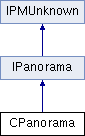
Public Member Functions | |
| CPanorama (IPMUnknown *boss, bool16 push_changes_into_drover=kFalse) | |
Panorama attributes | |
| virtual PMRect | GetCentralBounds () const |
| virtual PMReal | GetCentralBorderWhiteSpace () const |
| virtual void | SetPrimaryPanorama (IPanorama *panorama) |
| virtual IPanorama * | GetPrimaryPanorama () const |
| virtual void | GetPanoramaDelta (PMPoint &delta) const |
| virtual void | GetPanoramaDeltaMultiple (PMPoint &delta) const |
Scrolling | |
| virtual void | ScrollViewCenterTo (const PBPMPoint &newCenter, bool16 bForceRedraw=kTrue) |
| virtual PBPMPoint | ScrollTo_neg (const PBPMPoint &to, bool16 forceRedraw=kTrue, SysRgn InvalRgnCopy=nil) |
| virtual PBPMPoint | ScrollBy (const PBPMPoint &by, bool16 bForceRedraw=kTrue, SysRgn InvalRgnCopy=nil) |
| virtual PMPoint | GetAutoScrollDelta (const PBPMPoint &viewPoint) |
| virtual PMPoint | GetViewCenter () const |
| virtual PMPoint | GetScrollOffset_neg () const |
| virtual void | ScrollViewEdgeTo (const EdgeSpec &edgeSpec, const PBPMPoint &newCenter, bool16 bForceRedraw) |
Scaling | |
| virtual void | ScalePanorama (const PMReal &xFactor, const PMReal &yFactor) |
| virtual void | ScalePanoramaBy (const PMReal &xBy, const PMReal &yBy) |
| virtual PMReal | GetXScaleFactor (bool32 actualZoomLevelInsteadOfUIZoomWidgetValue=kTrue) const |
| virtual PMReal | GetYScaleFactor (bool32 actualZoomLevelInsteadOfUIZoomWidgetValue=kTrue) const |
| virtual PMReal | GetPreviousScaleFactor () const |
| virtual void | SetPreviousScaleFactor (PMReal scaleFactor) |
| virtual PMPoint | GetPreviousViewCenter () const |
| virtual PMReal | GetMinScaleFactor () const |
| virtual PMReal | GetMaxScaleFactor () const |
| virtual PMPoint | GetViewScrollOffset () const |
| virtual void | SetScrollOffset_neg (PMPoint scrollBy) |
Combinations | |
| virtual void | FitInView () |
| virtual void | FullView () |
Transform | |
| virtual void | UpdatePanoramaTransform (PMMatrix *transform) const |
Persistence | |
| virtual void | SavePerspective () const |
| virtual void | RestorePerspective () |
 Public Member Functions inherited from IPanorama Public Member Functions inherited from IPanorama | |
| virtual PMRect | GetBounds () const =0 |
| void | ScrollContentLocationToFrameCenter (const PBPMPoint &contentLocation, bool16 bForceRedraw=kTrue) |
| PBPMPoint | ScrollContentLocationToFrameOrigin (const PBPMPoint &contentLocation, bool16 forceRedraw=kTrue, SysRgn InvalRgnCopy=nil) |
| PMPoint | GetContentLocationAtFrameOrigin () |
| PMPoint | GetContentLocationAtFrameCenter () |
| Public Member Functions inherited from IPMUnknown | |
| virtual IPMUnknown * | QueryInterface (PMIID interfaceID) const =0 |
| virtual void | AddRef () const =0 |
| virtual void | Release () const =0 |
Protected Member Functions | |
| PMPoint | GetNearestValueBasedOnScaleFactor (PMPoint scrollDelta) |
Implementation | |
| virtual PMReal | GetScaleToShowRect (const PMRect &r, const PMReal &whiteSpace) const |
| virtual void | DoNotify (ClassID messageID, const PanoramaUpdateParams ¶ms) const |
| virtual void | GetBoundsForAutoScroll (PMRect &) const |
| virtual PBPMPoint | ConstrainTo (const PBPMPoint &value) const |
| virtual PBPMPoint | ConstrainBy (const PBPMPoint &delta) const |
| virtual SysRgn | SystemScroll (const SysPoint &sysDelta, bool16 bDoInval, GSysRect *bbox) |
Additional Inherited Members | |
| Public Types inherited from IPanorama | |
| enum | { kDefaultIID = IID_IPANORAMA } |
Shared default implementation of the IPanorama interface. Implementers of IPanorama should derive from CPanorama.
Override to constrain scrolling - default implementation is empty.
Override to constrain scrolling - default implementation is empty.
| protectedvirtual |
A ClassID, such as kScrollToMessage, kScrollByMessage, kScaleToMessage, or kScaleByMessage. See also IPanorama.h for information on PanoramaUpdateParams
| virtual |
Adjust the panorama to fill the view with the active spread. Override to change default implementation. In particular, override this if the content is not the layout view
Implements IPanorama.
| virtual |
See comments in IPanorama.h. Override to change default implementation.
Implements IPanorama.
Override to change the deltas used for auto scrolling. This implementation returns 0.
Implements IPanorama.
| protectedvirtual |
Adjust the given bounds rectangle, outside of which you'd like to autoscroll.
| virtual |
Override to provide the white space surrounding the central content. This implementation returns 0.
Implements IPanorama.
| virtual |
Note that GetBounds is pure virtual in IPanorama and is not implemented here. It must be implemented by derived classes of course as this base class can have no idea what the intrinsic content bounds is.Override to provide the central content contained in the panorama. Default implementation returns GetBounds() - so no special central content.
Implements IPanorama.
| virtual |
See comments in IPanorama.h
Implements IPanorama.
| virtual |
See comments in IPanorama.h
Implements IPanorama.
| virtual |
Override to change the deltas used for incremental scrolling (clicking in the scroll bar arrows). This implementation returns 1/12th the size of the view.
Implements IPanorama.
| virtual |
Override to change the deltas used for large scale scrolling (clicking in the scroll bar background). This implementation returns the size of the view.
Implements IPanorama.
| virtual |
See comments in IPanorama.h
Implements IPanorama.
| virtual |
See comments in IPanorama.h
Implements IPanorama.
| virtual |
Get the primary panorama.
Implements IPanorama.
| protectedvirtual |
Utility routine to compute the scale factor required to display a rectangular area, with a border.
| virtual |
See comments in IPanorama.h
Implements IPanorama.
| virtual |
See comments in IPanorama.h
Implements IPanorama.
| virtual |
See comments in IPanorama.h
| virtual |
See comments in IPanorama.h
Implements IPanorama.
| virtual |
See comments in IPanorama.h
Implements IPanorama.
| virtual |
Override to restore perspective - default implementation is empty.
Implements IPanorama.
| virtual |
Override to save perspective - default implementation is empty.
Implements IPanorama.
See comments in IPanorama.h
Implements IPanorama.
See comments in IPanorama.h
Implements IPanorama.
| virtual |
Override to change or augment default implementation. The default implementation does approximately the following:
fScrollOffset -= by * fScaleFactors;
Note that fScrollOffset is the location of the content origin in frame coordinates. Hence the 'by' vector is provided in content units and must be converted to frame units before adjusting fScrollOffset. Note also that a positive 'by' means move the content up/left in the frame so the user can see more of the content below/right of the frame currently. See comments in IPanorama.h
Implements IPanorama.
| virtual |
See comments in IPanorama.h
Implements IPanorama.
| virtual |
See comments in IPanorama.h
Implements IPanorama.
| virtual |
Override to change or augment default implementation
Implements IPanorama.
| virtual |
See comments in IPanorama.h
Implements IPanorama.
| virtual |
Set the primary panorama. This implementation attaches the seconday panorama (this) to the primary panorama as an observer, and makes sure they are initially in sync.
Implements IPanorama.
| virtual |
This function is for internal use only and will be removed in a future release.
| virtual |
Modify the passed in transform to match the current panorama scroll

offset and scaling
The only geometric data a widget stores (publicly) is its frame – accessible via IControlView::GetFrame(). This is a PMRect stored in the parent widget's content coordinate system. This means an IControlView has no intrinsic size or shape–it is simply expected to draw only in this allowed parent region. Most widgets "grow" or "shrink" their content exactly into this rectangle. A widget that has larger content that is to be viewed through this frame can add an IPanorama impl on its boss. This panorama can be used to scroll and zoom the widget content within the parent frame and to define some intrinsic size for the sake of scroll bars.
The panorama maintains the transform from the inner (or content) coordinates of this view (the boss containing the panorama impl) to what I'll here call "frame coordinates". Frame coordinates are aligned with and have the same scale as the content coordinates of the parent view but have its (0,0) point at the top-left corner of this view's frame. (In other words, to transform from frame coordinates to parent-content coordinates one simply translates by GetFrame().TopLeft().)
UpdatePanoramaTransform is expected to prepend onto the passed-in transform this incremental panorama effect–the content-to-frame transfrom. The matrix parameter is assumed to already contain the frame-coordinates to parent-content coordinates translation–as that much of the child-to-parent transform is assumed for all IControlViews and is available directly from GetFrame(). If one passes the identity matrix to UpdatePanoramaTransform, the result will be only the content-to-frame transfrom.
Note that the implementation of UpdatePanoramaTransform in CPanorama.cpp is simply:
transform = fScaleFactors * fScrollOffset * transform;
where fScaleFactors and fScrollOffset are, in effect, CPanorama's data members (really there are separate fXScaleFactor and fYScaleFactor, not a single member fScaleFactors). This means that fScrollOffset moves the content axes off the top-left frame corner first (in frame units) and then the content axes are stretched from that new origin location. (A positive offset stored in fScrollOffset means the content's origin is down or to the right from the top left corner of the frame–in our left-hand UI coordinate systems anyway.)
(Recall that from the point of view of moving coordinate axes around by the transform (leaving the inner (x,y) geometry alone), you work through the matrix from right to left. From the point of view of an (x,y) pair getting modified by the transform (leaving the axes alone), you work from left to right. So if you wanted to see where a point in content coordinates will end up in frame coordinates, you would scale the coordinate first by fScaleFactors and then translate by fScrollOffset. In other words, fScrollOffset is the location of the content's origin in frame coordinates.)
However, even though the panorama transform is stored as a pair of offsets (fScrollOffset) and a pair of scale factor (fXScaleFactor, fYScaleFactor) data members such that the total affect is the inner to frame matrix: fScaleFactors*fScrollOffset, the meaning of the rest of the API suggests a better implementation of the inner to frame matrix might have been: fScrollOffset*fScaleFactors. Or it may have been better to make the API take frame coordinates as parameters. In other words, it's odd that this implementation chose to implement the panorama like this: (considering just the x-coordinate in this sample)
xFrame = xInner*fXScaleFactor + fScrollOffset.X(); //scale inner coordinate first, then translate to get to frame coordinates
instead of like this:
xFame = (xInner + fScrollOffset.X())*fXScaleFactor; //translate inner coordinate first, then scale to get to frame coordinates
when, for example, the ScrollContentLocationToFrameOrigin method takes a location parameter in inner coordinates.
So in order to get the specified inner location to show up at the top-left corner of the frame (0,0) in frame coordinates, (the job of ScrollContentLocationToFrameOrigin), it needs to multiply the passed in parameter by the scale factor. That is, requiring:
0 = specified_value * fXScaleFactor + fScrollOffset.X()
And solving for fScrollOffset.X(), means that the implementation of ScrollContentLocationToFrameOrigin must be:
fScrollOffset.X() = -specified_value * fXScaleFactor;
The implementation code would have been more natural if the data members had the transposed meaning or if the API was in terms of frame locations instead of inner locations like so:
0 = (specified_value + fScrollOffset.X())*fXScaleFactor
And solved for fScrollOffset.X() would have simply been:
fScrollOffset.X() = -specified_value;
Oh, well...be warned as you'll see several contrivances multiplying and dividing by scale factors both in the CPanormama implementation and in clients of ITransform. (Is this worth fixing? Well it would be if the meaning of the API proved "wrong".)
For example, ScrollContentLocationToFrameOrigin expects its 'to' argument to be in the inner coordinate system of the view with the outcome that the location 'to' in the inner view be positioned at the origin of the frame coordinate systems, i.e. at the top-left corner of the view's frame. Since the panorama data members are interpreted "in the wrong order", the 'to' value must be multiplied internally by the scale before storing the result in fScrollOffset.
Implements IPanorama.
 1.8.3.1
