 | InDesign SDK 20.5 |
#include <IAppPrefsExportDelegate.h>
Public Types | |
| enum | { kDefaultIID = IID_IAPPPREFSEXPORTDELEGATE } |
Public Member Functions | |
| virtual bool16 | ShouldExportElement (IDOMElement *domElement, bool16 defaultShouldExportValue) const =0 |
| virtual void | ModifyExportOrder (const IDOMElement::ElementList &oldList, IDOMElement::ElementList &newList) const =0 |
| virtual void | ModifyExportedListElements (K2Vector< ScriptID > &exportedIDs) |
 Public Member Functions inherited from IPMUnknown Public Member Functions inherited from IPMUnknown | |
| virtual IPMUnknown * | QueryInterface (PMIID interfaceID) const =0 |
| virtual void | AddRef () const =0 |
| virtual void | Release () const =0 |
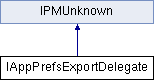
This is an interface for customizing the Export of Application Preferences exported via ISnippetExport::ExportAppPrefs() The methods in this interfaces are callbacks from the export process that allows the client to have a say in the export
| virtual |
When an export occurs, we keep track of the list element types(swatches, pdf presets, etc.) that have been exported. On import we use this list to determine which list element types to delete. Say we export 3 XML tags, A, B and C. Later, we have tags D, E and F and we import the prefs that contain A, B and C. After importing, if we have the DeleteNonImportedListItems preference turned on, we will know that D, E and F were not part of the import and will will remove them from the list. If during the export, we chose not to export tags, then on import no tags would have been imported. If we didn't keep a list of which types were exported, we wouldn't know whether to delete non-imported tags or not. The exportedIDs list allows us to keep track of the types of items that were exported. If you are exporting a 3rd party list item, you'll need to add it here to the list of exported items such that that information is available on import.
| exportedIDs | contains the list of exported types as ScriptIDs, which can be added to to acknowledge other exported list types |
| pure virtual |
The export process initially gathers children in no particular order. The import process requires some order to function correctly. Any item that is referenced by another item should come before the referencing item in the export list. For all known types, this sorting is done for you before this method is called. This method is typically used to move a 3rd party element higher up in the export list so it comes before something that depends on it.
| oldList | this is the list of elements in the order they will be exported |
| newList | if changes are made to the export order, newList should contain a complete list of the exporting objects in their new export order. newList will be empty when this method is called and if it is empty on return, oldList will be used. i.e. to do nothing, just return. |
| pure virtual |
The export process goes thru all objects that are children of the application DOM element and will ask whether each should be exported. to get default behavior, just return defaultShouldExportValue An expected use of this delegate is to include elements provided by 3rd parties in the export. Typically, only objects that are considered preferences or list items that have been specifically included would be exported. If you have an element that is a child of the application DOM but is not a preference, you'd want to use the delegate to return kTrue to get this element exported
| domElement | the DOM element you are being asked to include or exclude in the export |
| defaultShouldExportValue | the default value that would occur if there was no delegate. |
 1.8.3.1
