 | InDesign SDK 20.5 |
#include <IVisitorHelper.h>
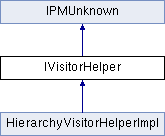
Public Types | |
| enum | { kDefaultIID = IID_IVISITORHELPER } |
Public Member Functions | |
| virtual bool16 | Accept (IBaseVisitor *theVisitor)=0 |
| virtual int32 | CollectChildren (IBaseHandler *theHandler)=0 |
| virtual IVisitorHelper * | QueryChild (int32 index)=0 |
 Public Member Functions inherited from IPMUnknown Public Member Functions inherited from IPMUnknown | |
| virtual IPMUnknown * | QueryInterface (PMIID interfaceID) const =0 |
| virtual void | AddRef () const =0 |
| virtual void | Release () const =0 |
A helper class, used with IBaseVisitor and IBaseHandler, to facilitate accomplishing tasks

while traversing an arbitrary structure of nodes (typically of items on a spread).  IVisitorHelper is

the "glue" that is aggregated to a structure node to enable it to be visited, as well as to hand

control off to a handler routine for accomplishing a given task.


The IVisitorHelper::Accept routine is based on the visitor design pattern from Gamma, et al., in tandem

with the methods of IBaseVisitor.  It is the IVisitorHelper implementation on a given node boss that contains

the knowledge of how links to child nodes are maintained.  For instance, while pageitems are typically

linked by the IHierarchy interface in InDesign, the IVisitorHelper scheme doesn't require any specific

interface to be supported by nodes; each node's implementation of IVisitorHelper utilizes the linkage

mechanism native to the node to which it is aggregated.  Because of this, it is not even a requirement that

all nodes in a given structure utilize a common linkage mechanism, in order for the visitor/handler scheme to

operate.


NOTE: Third-party-created pageitems that are not derived from built-in InDesign page item bosses must contain

an IVisitorHelper interface on the page item boss in order for hit-testing to be supported for the item.

Also, since VisitXXX and HandleXXX routines aren't defined for these pageitems in IBaseVisitor and IBaseHandler,

these should be provided by custom implementations that are added-in to the kBaseVisitorBoss and kPtrHitTestHandlerBoss

(respectively).  The kPtrHitTestHandlerBoss is the base boss for InDesign hit-testing; several other boss

classes derive from it.


Sample code for setting up the visitor, handler, and root item's visitor helper for a hit-testing scenario

<pre>
Assume defined: PMRect hitRect; // a target rect to hit-test IControlView view; // the current view UIDList* pTheSpreads; // a list of spreads visible in the view ClassID handlerClass; // ClassID of a handler boss that knows how to do hit-testing for each node type
AGMGraphicsContext gc(view);

PMMatrix theXForm = gc.GetTransform();

theXForm.Transform(&hitRect);


IDataBase* theDB = pTheSpreads->GetDataBase();
Create a visitor and the appropriate Handler for what we want to do. InterfacePtr<IBaseVisitor> theVisitor((IBaseVisitor*)::CreateObject(kBaseVisitorBoss, IID_IBASEVISITOR)); InterfacePtr<IBaseHandler> theHandler((IBaseHandler*)::CreateObject(handlerClass, IID_IBASEHANDLER));
Load the visitor and handler with setup data. theVisitor->InitVisitor(theDB, theHandler);
Our hit-test handler boss keeps the hit rect on this interface; yours may store other things on add-ins InterfacePtr<IBaseSelectionHandlerData> theHandlerData(theHandler, IID_IBASESELECTIONHANDLERDATA); theHandlerData->Set(hitRect); Handler boss uses one of its own interfaces for results of the hit-test task InterfacePtr<IUIDListData> theResults(theHandler, IID_IUIDLISTDATA); theResults->Set( new UIDList( theDB ));
loop through the spreads until a hit is found bool16 bDone = kFalse;
GraphicsDataPtr gd(&gc); for (int32 i = 0; i < pTheSpreads->Length() && !bDone; i++) { InterfacePtr<IShape> spreadShape(pTheSpreads->GetRef(i), IID_ISHAPE); if (theVisitor && theHandler && spreadShape) { IBaseHandler t = theHandler; BaseHitTestHandlerImpl bhth = reinterpret_cast<BaseHitTestHandlerImpl*>(t); bhth->InitHandler(gd, spreadShape);
Call Accept on the spread with the visitor InterfacePtr<IVisitorHelper> theHelper(spreadShape, IID_IVISITORHELPER); if (theHelper) bDone = theHelper->Accept(theVisitor); bhth->TerminateHandler(); } } Upon completion, handler boss might have left interesting data on one of its interfaces. In this example, the hit items are in theResults. The bDone value tells whether it actually found anything.
</pre>
| pure virtual |
        Initiate traversal for the node.

        The Accept routine's role is to call the routine in theVisitor appropriate for the node.  For built-in

        nodes in InDesign, this means calling one of the IVisitor::VisitXXX routines.  An Accept routine

        for a custom node "MyNode" might look like the following, assuming a custom IMyNodeVisitor interface has been added-in to

        the kBaseVisitorBoss to pass control to the proper routine in the handler:

        <pre>

bool16 MyNodeVisitorHelperImpl::Accept(IBaseVisitor* theVisitor)

{

    bool16 bDone = kFalse;
Query the interface added-in to kBaseVisitorBoss to visit my node InterfacePtr<IMyNodeVisitor> myVisitor(theVisitor, UseDefaultIID()); Call the Visitor without knowing anything about what its handler is going to do if (theVisitor) bDone = myVisitor->VisitMyNode(this); return bDone; }
| theVisitor | IN a pointer to the IBaseVisitor that knows how to pass control off to specific visitor routines, depending on the type of node found |
Implemented in HierarchyVisitorHelperImpl.
| pure virtual |
Determine how many children this node has, and if necessary, do any allocation or caching needed when individual children are accessed via QueryChild.
| theHandler | IN pointer to the IBaseHandler in use for this visitation. This may be useful for interrogating information from the handler – for instance, the GetHandlerIntersectionRect() routine to determine the target rectangle in a hit-testing task (useful for trivial rejection). |
Implemented in HierarchyVisitorHelperImpl.
| pure virtual |
Query for a specific child of this node.
| index | IN the index of the node desired (zero-based) |
Implemented in HierarchyVisitorHelperImpl.
 1.8.3.1
