#include <IBehaviorData.h>
|
| enum | { kDefaultIID = IID_IBEHAVIORDATA } |
| |
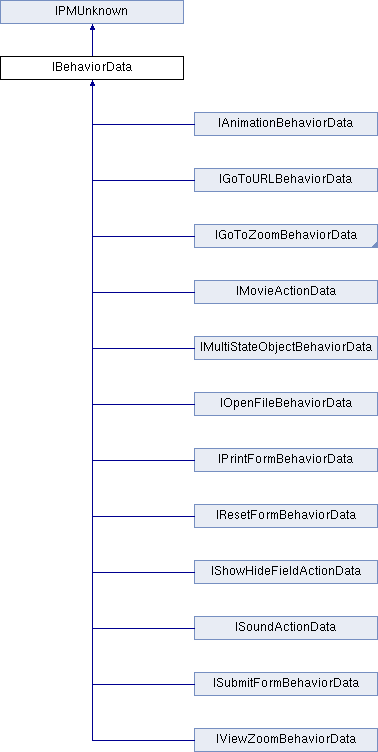
Base data interface for all behavior bosses Each behavior has an interface that inherits from this interface that contains methods to access the parameters specific to that behavior
- See Also
- IBehaviorList, IMovieActionData
| virtual void IBehaviorData::Copy | ( | IPMUnknown * | srcData | ) | |
| pure virtual |
Copy parameters from one IBehaviorData interface to another.
- Parameters
| virtual bool16 IBehaviorData::Enable | ( | const bool16 & | enable = kTrue | ) | |
| pure virtual |
Enable or Disable this behavior, that is whether it should be exported in the output PDF
| virtual int32 IBehaviorData::GetAction | ( | | ) | const |
| pure virtual |
Get an unique enumeration, a PMID in kBehaviorIDSpace, for this behavior
| virtual PMString IBehaviorData::GetName | ( | | ) | const |
| pure virtual |
Get a human readable name for the behavior
| virtual UID IBehaviorData::GetOwner | ( | | ) | const |
| pure virtual |
Get the UID of the boss to which this behavior belongs. Typically, a behavior boss belongs to an IBehaviorList interface which is an event/behavior list map. IBehaviorLists are interfaces on Form Field and Document bosses, for instance. So this would return the UID of a form field or document.
| virtual bool16 IBehaviorData::IsEnabled | ( | | ) | const |
| pure virtual |
Return if this behavior is enabled, that is whether it should be exported in the output PDF
| virtual void IBehaviorData::SetOwner | ( | const UID & | owner | ) | |
| pure virtual |
Set the owner of the boss that this behavior belongs to
- Parameters
| owner | UID of boss that owns the behavior |

 Public Member Functions inherited from IPMUnknown
 1.8.3.1
