 | InDesign SDK 20.5 |
#include <IPreflightAggregatedResultsUtils.h>
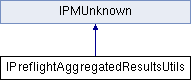
Public Types | |
| enum | { kDefaultIID = IID_IPREFLIGHTAGGREGATEDRESULTSUTILS } |
| enum | { kAggregateDifferentSubparts = (1L<<0), kAggregateTextRangesWithDifferentValues = (1L<<1), kAggregateCellsWithDifferentValues = (1L<<2), kDoNotAggregateSingluarValueSubparts = (1L<<3) } |
| typedef InterfacePtr < IPreflightResultRecordTable > | ResultTableIFP |
| typedef K2Vector< ResultTableIFP > | VectorOfTables |
| typedef K2Vector< int32 > | VectorOfIndices |
Public Member Functions | |
| virtual IPreflightAggregatedResults * | CreateAggregatedResults () const =0 |
| virtual IPreflightResultRecord * | CreatePreflightResultRecord () const =0 |
| virtual IPreflightResultRecordTable * | CreatePreflightResultRecordTable () const =0 |
| virtual IPreflightResultNodeInfo * | CreatePreflightResultNodeInfo () const =0 |
| virtual IPreflightResultRecordTable * | CreateTableFromNodes (const IPreflightProcess *iProcess, const IPreflightProcess::NodeIDVector &resultNodes) const =0 |
| virtual const IPreflightResultRecordTable * | ApplyAllStandardAggregations (const IPreflightProcess *iProcess, const IPreflightResultRecordTable *iTable, uint32 aggregationFlags=0) const =0 |
| virtual const IPreflightResultRecordTable * | AggregateMarkingOperationsToUsefulObjects (const IPreflightProcess *iProcess, const IPreflightResultRecordTable *iTable, uint32 aggregationFlags=0) const =0 |
| virtual const IPreflightResultRecordTable * | AggregateContiguousTextRanges (const IPreflightResultRecordTable *iTable, uint32 aggregationFlags=0) const =0 |
| virtual const IPreflightResultRecordTable * | AggregateContiguousCells (const IPreflightResultRecordTable *iTable, bool horizontally, uint32 aggregationFlags) const =0 |
| virtual const IPreflightResultRecordTable * | AggregateDifferentSubpartsSameEverythingElse (const IPreflightResultRecordTable *iTable, uint32 aggregationFlags=0) const =0 |
| virtual const IPreflightResultRecordTable * | CreateSubTable (const IPreflightResultRecordTable *iSrcTable, const VectorOfIndices &indices) const =0 |
| virtual IPreflightResultRecordTable * | CreateSubTableByCriteria (const IPreflightResultRecordTable *iSrc, ClassID criteriaID, bool invertCriteria=kFalse) const =0 |
| virtual void | CreateTablesByCriteria (const IPreflightResultRecordTable *iSrcTable, VectorOfTables &tables) const =0 |
| virtual void | CreateTablesByAuxString (const IPreflightResultRecordTable *iSrcTable, VectorOfTables &tables) const =0 |
| virtual void | CreateTablesByObject (const IPreflightResultRecordTable *iSrcTable, VectorOfTables &tables) const =0 |
| virtual bool | IsPlacedContent (const IPreflightResultRecord *iRec) const =0 |
| virtual PMString | FormatXMeasure (const IPreflightProcess *iProcess, const PMReal &x) const =0 |
| virtual PMString | FormatYMeasure (const IPreflightProcess *iProcess, const PMReal &y) const =0 |
| virtual PMString | FormatLineMeasure (const IPreflightProcess *iProcess, const PMReal &x) const =0 |
| virtual PMString | FormatTextSizeMeasure (const IPreflightProcess *iProcess, const PMReal &x) const =0 |
| virtual PMString | FormatResolution (const PMReal &x) const =0 |
| virtual PMString | FormatAsInteger (const PMReal &x) const =0 |
| virtual PMString | GetSubpartsDescription (const IPreflightResultRecord *iRec, bool forceTranslation=kTrue) const =0 |
| virtual IPreflightAggregatedResults::NodeID | AddCriteriaNode (IPreflightAggregatedResults *iResults, IPreflightAggregatedResults::NodeID parentID, const PMString &nodeText, const PreflightRuleID &ruleID) const =0 |
| virtual IPreflightResultNodeInfo * | CreateViolationNode (const PreflightObjectID &objID) const =0 |
| virtual IPreflightResultNodeInfo * | CreateCriteriaAndViolationNode (const PreflightObjectID &objID, const PMString &nodeName, const PreflightRuleID &ruleID) const =0 |
| virtual IPreflightResultNodeInfo * | CreateGenericNode (const PMString &nodeName, const PreflightRuleID &ruleID) const =0 |
| virtual IPreflightAggregatedResults::NodeID | AddResultsNode (IPreflightAggregatedResults *iResults, IPreflightAggregatedResults::NodeID parentID, IPreflightResultNodeInfo *iInfo) const =0 |
| virtual void | AddProxyCriteriaAndNodes (IPreflightAggregatedResults *iResults, IPreflightAggregatedResults::NodeID parentID, const IPreflightResultRecordTable *iProxyTable, const PMString &criteriaName, const PreflightRuleID &ruleID) const =0 |
 Public Member Functions inherited from IPMUnknown Public Member Functions inherited from IPMUnknown | |
| virtual IPMUnknown * | QueryInterface (PMIID interfaceID) const =0 |
| virtual void | AddRef () const =0 |
| virtual void | Release () const =0 |
Utilities that rules use to create aggregated results. These are normally called from IPreflightRuleVisitor::AggregateResults() but may be appropriate in some other cases too.
| anonymous enum |
Flags for ApplyAllStandardAggregations et al.
| pure virtual |
Creates and adds a criteria node, which is just a heading corresponding to the rule or criteria. This node does
| iResults | IN The results tree pointer. |
| parentID | IN The node under which you want to add the new node. |
| nodeText | IN The name of the node (appears in the tree). |
| ruleID | IN The rule ID to assign to the criteria node. This is needed for node-ordering purposes. |
| pure virtual |
Adds a proxy criteria and proxy nodes. If your rule visits artwork but finds that a proxy is being drawn instead of the placed content, and wants to report it as a proxy violation, you can use this utility to auto-build the generic node and children.
| iResults | IN The results tree to which you want to add the nodes. |
| parentID | IN The node that the new nodes should be a child of. |
| iProxyTable | IN The table of proxies, typically created via CreateTablesByCriteria or CreateSubTableByCriteria, using kPreflightRC_GraphicProxy as the parameter. |
| criteriaName | IN The text to use for the generic node under which the individual proxy nodes are listed. |
| ruleID | IN The rule ID to assign to the criteria node. This is needed for node-ordering purposes. |
| pure virtual |
Adds a result node to the aggregated results tree. For now this is simply a wrapper around iResults->AddNode() but in the future we may add some additional verification or utility, so in general you should work through this API.
Note that within the parent, the children are auto-ordered according to their sort values.
| iResults | IN The results tree to which you want to add the node. |
| parentID | IN The node that the new node should be a child of. |
| iInfo | IN The node info pointer. The results tree addrefs this and holds onto it until the tree is destroyed. |
| pure virtual |
This is one of the methods called from ApplyAllStandardAggregations. It finds table cells that are contiguous either horizontally or vertically, AND have the same criteria, values, aux strings, and subparts. If kAggregateCellsWithDifferentValues is passed, values are not considered for aggregation purposes.
| iTable | IN The table to aggregate. |
| horizontally | IN If true, aggregates ranges together that share the same rows and are contiguous in columns. If false, aggregates ranges together that share the same columns and are contiguous in rows. |
| aggregationFlags | IN Flags; only kAggregateCellsWithDifferentValues applies here. |
| pure virtual |
This is one of the methods called from ApplyAllStandardAggregations. It finds text runs and ranges that are contiguous and have the same criteria, values, aux strings, and subparts. If kAggregateTextRangesWithDifferentValues is passed, values are not considered for aggregation purposes.
| iTable | IN The table to aggregate. |
| aggregationFlags | IN Flags; only kAggregateTextRangesWithDifferentValues applies here. |
| pure virtual |
This is one of the methods called from ApplyAllStandardAggregations.
It aggregates together all records which differ only in subparts. This is to allow for neater presentation of results when all subparts otherwise share the same failure cases.
| iTable | IN The table to aggregate. |
| aggregationFlags | IN Flags. None apply here but leaving for future expansion. |
| pure virtual |
This is one of the methods called from ApplyAllStandardAggregations. It "uplevels" all marking operation records into their related higher-level selectable objects, namely page items, text runs, and table cells. The subpart for these upleveled entries will be any known subpart (eg kPreflightOSP_NativeStroke).
This method will combine unlike values together but will not by default combine unlike subparts. Passing kAggregateDifferentSubparts will allow subpart aggregation but then you won't be able to tell which subpart a given value came from if there is a plurality of both.
| iProcess | IN The process; required in order to walk the process nodes to find the parents of marking operations. |
| iTable | IN The table to aggregate. |
| aggregationFlags | IN Flags; only kAggregateDifferentSubparts applies here. |
| pure virtual |
Applies "standard" aggregations and consolidations for a given table. In general the results you get from a preflight visit can be large especially when considering objects like text runs. This method consolidates (aggregates) entries that share common traits, like contiguous text runs with the same criteria and artwork in placed content.
Typically this is called immediately after CreateTableFromNodes, but not necessarily. In some cases you may wish to do your own prefiltering into tables and then call this method to avoid aggregation together of entries you do not want to be autogrouped. In general, after calling this method, you will not have process node information (if the nodes have been aggregated there is no longer one unique value), and values and subparts may have been aggregated together.
(More explanation to follow.)
| iProcess | IN The process. This is required in order to deal with artwork and other entities where we need to look at the result node hierarchy. |
| iTable |
| pure virtual |
Create an empty preflight aggregated results tree.
| pure virtual |
Creates a node that is both criteria AND violation. This is used when a rule can have only a single violation node, so we combine criteria and violation together.
This does not add the node to the tree. To do that use AddResultsNode() where you can specify the parent.
| objID | IN The object that represents the violation (typically the document). |
| nodeName | IN The name of the node (criteria). |
| ruleID | IN The rule ID to assign to the criteria node. This is needed for node-ordering purposes. |
| pure virtual |
Creates a generic (just a name) node. This node has no object by default, just a name; so typically it's used for some kind of grouping.
Note that this creates the record but doesn't add it to the tree. When you're done setting it up, call AddResultsNode().
| nodeName | IN The name of the node (shown in the tree). |
| ruleID | IN The rule ID to assign to the node. This is needed for node-ordering purposes. If you know for sure this node will never compete for order, or the name is sufficient, you can pass PreflightRuleID(). Or you can pass PreflightRuleID() and then use IPreflightAggregatedResultData::SetRootSortValue() to have complete control. |
| pure virtual |
Create an empty preflight result node info. This is a kPreflightResultNodeBoss so you can query for IPreflightResultNodeData to fill in the details.
| pure virtual |
Create an empty preflight results record. You'll need to fill in all the details. This isn't typically done except private to the utilities, but there's no reason you can't create your own.
| pure virtual |
Create an empty preflight results record table. This isn't typically done except private to the utilities, but there's no reason you can't create your own and add records to it.
| pure virtual |
Builds a second table that consists of the specified indices from the first table. This method is pretty fast because it's only managing refcounts on the records, not actually copying their data.
| iSrcTable | IN The table from which you want to copy records. |
| indices | IN The indices from the table you want to copy. |
| pure virtual |
Builds a second table by putting in it only records with a particular criteria. This method is pretty fast because it's only managing refcounts on the records, not actually copying their data.
| invertCriteria | IN If true, invert the selection; ie put in only entries whose criteria is NOT criteriaID. |
| pure virtual |
Given a set of result nodes from a process, create a Result Record table. This is usually the starting point for rule result aggregation.
| iProcess | IN The process. |
| resultsNodes | IN The vector of result node IDs. |
| pure virtual |
Builds a set of derivative tables corresponding to unique values of aux string. This is useful if you want to give parent-child results where the parents are unique aux strings. Eg if you're presenting results grouped by font name, you can put the font name in the aux string when visiting nodes then use this method to build aggregated results accordingly.
| iSrcTable | IN The source table from which you want to sort records. |
| tables | OUT Receives the array of tables, where each table corresponds to all records from iSrcTable with the same aux string. |
| pure virtual |
Builds a set of derivative tables corresponding to unique values of criteria. This is useful if you want to give parent-child results where the parents are unique criteria. This is typically done when you have numerous criteria and want to share a common formatting subroutine.
| iSrcTable | IN The source table from which you want to sort records. |
| tables | OUT Receives the array of tables, where each table corresponds to all records from iSrcTable with the same criteria. |
| pure virtual |
Builds a set of derivative tables corresponding to unique object IDs. This is commonly used if you want to guarantee a single node for each object (and if there are multiple violations per object you want to put that information in the info strings as concatenated results).
| iSrcTable | IN The source table from which you want to sort records. |
| tables | OUT Receives the array of tables, where each table corresponds to all records from iSrcTable with the same object ID. |
| pure virtual |
Creates a node corresponding to a violating object. The name of the node is automatically generated based on the object, as are the automatic selection capabilities. You can fill in explanatory text by querying IPreflightResultNodeData and adding in additional strings.
This does not add the node to the tree. To do that use AddResultsNode() where you can specify the parent.
| objID | IN The object to use for the node. |
| pure virtual |
Formats the value as an integer. Should generally be used for actual integer values. Will round to the nearest integer. Result is a non-translatable string.
| pure virtual |
Formats the given value (in points) as a line width.
| iProcess | IN The process. This is required in order to get the document's unit of measure settings to use when formatting the given value. |
| x | IN The value (in points) to format. |
| pure virtual |
Formats the given value (in ppi) as a resolution.
| pure virtual |
Formats the given value (in ppi) as a text size.
| iProcess | IN The process. This is required in order to get the document's unit of measure settings to use when formatting the given value. |
| x | IN The value (in ppi) to format. |
| pure virtual |
Formats the given value (in points) as an X measure.
| iProcess | IN The process. This is required in order to get the document's unit of measure settings to use when formatting the given value. |
| x | IN The value (in points) to format. |
| pure virtual |
Formats the given value (in points) as a Y measure.
| iProcess | IN The process. This is required in order to get the document's unit of measure settings to use when formatting the given value. |
| y | IN The value (in points) to format. |
| pure virtual |
Returns true if the record corresponds to placed content (or child marks).
 1.8.3.1
