 | InDesign SDK 20.5 |
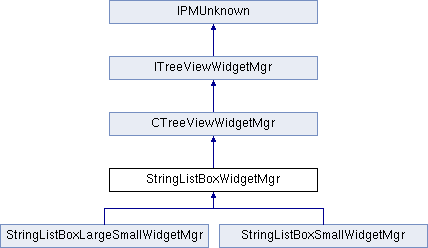
Public Member Functions | |
| StringListBoxWidgetMgr (IPMUnknown *boss) | |
 Public Member Functions inherited from CTreeViewWidgetMgr Public Member Functions inherited from CTreeViewWidgetMgr | |
| CTreeViewWidgetMgr (IPMUnknown *boss) | |
| CTreeViewWidgetMgr (IPMUnknown *boss, int32 optionFlags) | |
| virtual | ~CTreeViewWidgetMgr () |
| virtual PMReal | GetIndentForNode (const NodeID &node) const |
| virtual void | SetStyle (int32 styleIdentifier) |
| virtual int32 | GetStyle () const |
| virtual WidgetID | GetWidgetTypeForNode (const NodeID &node) const |
| virtual void | PreDeleteWidget (IControlView *widget) |
Widget Factory and reuse | |
Widget placement | |
Widget Style - The tree view may have different looks, i.e. Large vs. Small palette rows | |
| Public Member Functions inherited from IPMUnknown | |
| virtual IPMUnknown * | QueryInterface (PMIID interfaceID) const =0 |
| virtual void | AddRef () const =0 |
| virtual void | Release () const =0 |
Protected Member Functions | |
| virtual bool16 | ApplyNodeIDToWidget (const NodeID &node, IControlView *widget, int32 message=0) const |
| virtual bool16 | ApplyDataToWidget (const NodeID &node, IPanelControlData *widgetList, int32 message=0) const |
| virtual PMReal | GetNodeWidgetHeight (const NodeID &node) const |
| virtual void | RegisterStyles () |
| virtual PMString | GetStringFromControlData (int32 nodeIndex) const |
| virtual IControlView * | CreateWidgetForNode (const NodeID &node) const |
| virtual PMReal | GetNodeWidgetWidth (const NodeID &node) const |
| Protected Member Functions inherited from CTreeViewWidgetMgr | |
| virtual void | ApplyIndentToWidget (const NodeID &node, IPanelControlData *widgetList, int32 message=0) const |
| virtual PMReal | GetBaseIndentOffset (IControlView *styleWidget) const |
| virtual PMReal | GetTreeViewWidth () const |
| virtual void | ApplyHighlightToWidget (const NodeID &node, IControlView *widget, int32 message=0) const |
| virtual PMReal | GetIndent (const NodeID &node) const |
| virtual void | RegisterStyleWidget (int32 style, RsrcID widgetRsrcID, PluginID pluginID) |
| virtual void | HideExpanderIfNotExpandable (const NodeID &node, IPanelControlData *widgetList, int32 message=0) const |
| virtual void | SetNodeName (IPanelControlData *widgetList, const PMString &name, WidgetID nameWidget=kTreeNodeNameWidgetID) const |
| virtual void | SetNodeIcon (IPanelControlData *widgetList, RsrcID iconRsrc, PluginID pluginID=0, WidgetID iconWidget=kTreeNodeIconWidgetID) const |
| virtual bool16 | IsOptionSet (Options option) const |
| virtual void | SetSelectableDlgDrawNodeSeparatorOff (IControlView *widget) const |
Additional Inherited Members | |
| Public Types inherited from ITreeViewWidgetMgr | |
| enum | { kDefaultIID = IID_ITREEVIEWWIDGETMGR } |
| Protected Types inherited from CTreeViewWidgetMgr | |
| enum | Options { kList = 0, kHierarchical = 1 } |
| protectedvirtual |
Most TreeViews will override this method. This method is called from ApplyNodeIDToWidget() to apply the Node specific data to the widgets within the main node widget. Typically, the name of the node and icon for the node are applied to a Text widget and an icon widget. When overriding this method, the base class version is not typically called.
| node | the node whose data you want applied to the given widget |
| widgetList | This is the IPanelControlData of the Tree node widget. The Tree node widget typically contains subwidgets which are changed based on the specific data for the given node. |
| message | if you call an ITreeViewMgr method with a message, that message will be passed back to you in this parameter. For instance, if it is expensive to update the text, but not the icon. You could pass yourself a kMyIconChanged message in ITreeViewMgr::NodeChanged() and then only update the icon in ApplyDataToWidget() if message=kMyIconChanged |
Reimplemented from CTreeViewWidgetMgr.
| protectedvirtual |
Change data in your nodeWidget(widget) to reflect the node passed in.
| node | specifies node to be rendered |
| widget | this is where the data from the node should be rendered |
| message | if you call an ITreeViewMgr method with a message, that message will be passes back to you in this parameter. For instance, if it is expensive to update the text, but not the icon. You could pass yourself a kMyIconChanged message in ITreeViewMgr::NodeChanged() and then only update the icon in ApplyDataToWidget() if message=kMyIconChanged |
Reimplemented from CTreeViewWidgetMgr.
| protectedvirtual |
Create the widget, but don't change the widget-data to match the node; that should be done in ApplyNodeIDToWidget
| node |
Reimplemented from CTreeViewWidgetMgr.
| protectedvirtual |
Returns desired height in pixels of widget rendering given node.
| node | |
| return | desired height in pixels of widget rendering given node |
Reimplemented from CTreeViewWidgetMgr.
| protectedvirtual |
Returns desired width in pixels of widget rendering given node.
| node |
Reimplemented from CTreeViewWidgetMgr.
| protectedvirtual |
This method is where you specify the widget that should be used for each of the Tree Styles you support. If you only support 1 Tree Style, then you need only Register one style in from this method. This method is automatically called when it is time to register your styles. Inside you should call RegisterStyleWidget() to asssociate a widget with a style.
If your tree can contain different widgets depending on the NodeID, then you should use override CreateWidgetForNode instead of this RegisterStyles() method
This default implementation registers the standard Tree widgets for large and small palette rows. If you aren't using the standard widgets, then override this and DON'T CALL the base class method.
Reimplemented from CTreeViewWidgetMgr.
Reimplemented in StringListBoxLargeSmallWidgetMgr, and StringListBoxSmallWidgetMgr.
 1.8.3.1
